
What It Means to Be the First? Fred Jung on leadership, responsibility, and paving your own path.
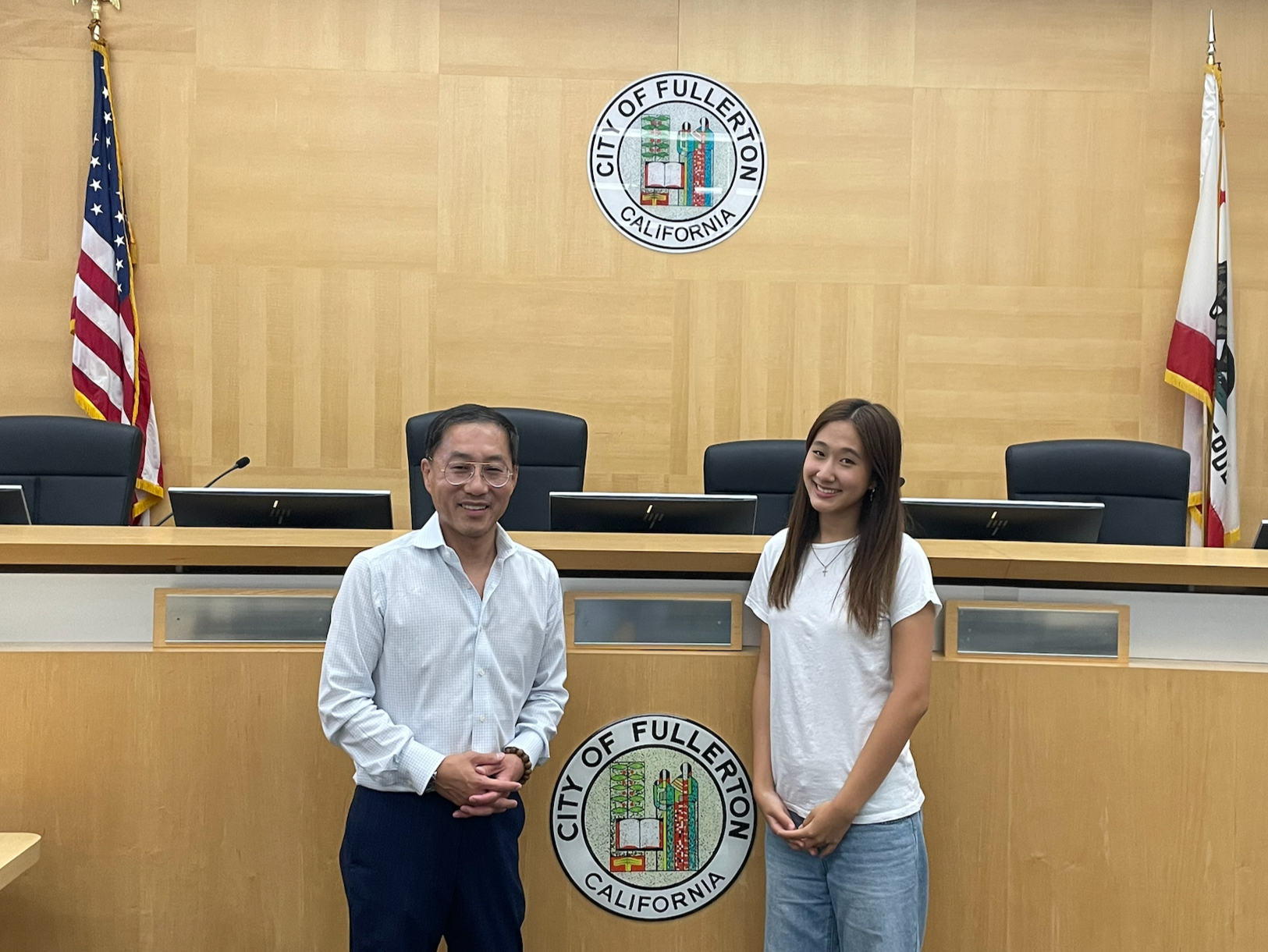
Mayor Fred Jung and Janis Kim during their interview at Fullerton City Hall.
The Making of a Leader
For many, leaders are individuals with a high title or position. But for Fred Jung, Mayor of Fullerton, his story didn’t begin with a title.
Growing up as eldest son with a sister 13 years younger than him, Fred Jung learned the weight of responsibility early on in his life. His mother worked at Weinerschizzle and would come home smelling like fries, and his dad made nuts and bolts. Though he never once doubted his parents’ hard work or their love for him and his sister, his parents coming home late at night gave him the capacity to be independent.
That sense of integrity became a crucial part of his personality.
The summer before 2nd grade, Jung moved to a different elementary school where students were given the chance to compete in a reading contest—whoever read the most books within one year won. He read 3-4 books per day and ended up reading 786 books within the year. Confident he would win, he waited for him to be crowned 1st place. But, his name was called too soon. He came in second place.
After hours of sobbing, his mom finally came home and told him something simple: read one more book per day and you win.
The lesson stayed with him.
“Do a little bit more.”
Little did he know, that mindset of doing a bit more each time would follow him far beyond the classroom.
Learning to See Within
Jung’s first step towards public service was knocking on doors in the Nickerson Garden housing projects at Watts. At the time, the area was experiencing severe violence, and so, Jung, being fresh out of college, was very nervous. However, one interaction changed his whole perspective on life.
Though some houses were rude and even some doors stayed shut, one elderly woman opened the door, invited him inside her home, and made him breakfast.
Through this experience, he realized that though people come from completely different backgrounds, we have more in common than we have different. It taught him that we are all human, and sometimes, we need to give each other the benefit of the doubt.
Frustration to Action
At 25, Jung bought his first house, essentially spending all the money he had saved. Because he wanted to paint his house, he went to a HOA meeting. Surprisingly, all the HOA board members were White and all the people seeking approval were Korean. Seeing that there were problems with communication, he began to translate for both languages.
Then, he was invited to join the HOA board as the first Korean American.
Afterwards, he noticed an issue: all neighborhood streets have been allocated funding for improvement, but one street was left untouched—Burning Street.
Motivated by this inequality, Jung fundraised $25,000 to be solely spent on this street. With that money, he approached the mayor to ask for additional funding; he was rejected.
The other HOA board members were frustrated. They told him, “If you want to fix the problem, run for mayor, and fix it yourself.” Jung took this seriously. Now, he wasn’t simply running for a title. He started with a problem in his own neighborhood that took him to a position where he could help address even bigger ones.
Making Difficult Decisions
One of his hardest decisions came before he was even sworn into an office. One month before his term officially started, the city of Fullerton passed a law legalizing marijuana sales. Immediately after Jung became a councilmember, the senior pastor of Grace Korean Church called him into his office and requested him to repeal the law in order to become a God serving city and to set a good example for young students.
Jung agreed.
Despite other council members arguing that the city could receive millions of dollars in revenue with the establishment of the tax, Jung did not budge. For him, no amount of money would be enough for him to change his mind.
Jung believes that there isn’t a clear difference between a good leader and a great one. Instead, he believes that how specific leaders respond to given circumstances reveals their leadership skills. To him, leadership isn’t about having great ideas, it’s about being able to rise up at any given moment and take the necessary action.
The Weight of Being First
For Jung, there is another big weight on his shoulders: representation.
As a Korean-American, he describes that being in a position like his comes with great privilege, but also burden.
He says, “The thing about being first is that if you don’t do a good job you may be the last.”
That feeling of responsibility comes with major sacrifices. He notes that a mayor is a part-time job, and though he is at the age where he is supposed to reach his maximum earning potential, he gets a relatively small financial compensation.
Still, he is eternally grateful to be in a position where we can set an example for younger students.
In the next decade, Jung hopes that Orange County will continue to develop a stronger Korean-American community. He hopes that people of all backgrounds will gather together to be able to call this place home, while still living up to their cultural heritage and background.
To Catalyst Readers
When asked what the biggest mistake students are making was, Jung’s answer was immediate: they are in too much of a hurry. He believes that young people have something incredibly valuable: time.
He also emphasizes the importance of who you surround yourself with. These people shape your lifestyle and habits which can either pull you up or push you down.
But his most memorable piece of advice was:
“In life, it’s very important to be a traveler, not a tourist.”
Tourists follow the crowd—they go visit popular landmarks, eat where everyone else does, take pictures and photospots, etc. But, a traveler explores deeper. They explore the community, eat where locals eat, and experience something that is far more authentic.
For students, this lesson extends beyond travel. Don’t always do what other people are doing. Don’t choose the easy way out. Pave your own path even if it’s hard.
Jung compares young Korean American students to the turtle ships that Admiral Yi Sun-Shin administered during the Imjin war against Japanese attacks. In the end, the small number of Korean turtle ships outbeat the larger and better equipped Japanese ships. Mayor Jung states that we, Korean Americans of the next generation, may be few in number, but we are more powerful than we know. We must carry the burden of the generations that came before us, but that responsibility is something to be proud of.
Perhaps, that’s the kind of leader Mayor Fred Jung is. More than anything, his main goal is to carry forward the legacy of his ancestors. From a second grade reading competition to knocking on doors to becoming part of the HOA board to serving as Fullerton Mayor, Jung’s path wasn’t built with a grand plan in mind. Instead, it was built through small experiences of leadership and responsibility.
